Plastic Injection Molding Software: Why Most Shops Are Still Flying Blind
The operational gap between what your ERP tracks and what actually happens on the press floor is costing you money every shift.
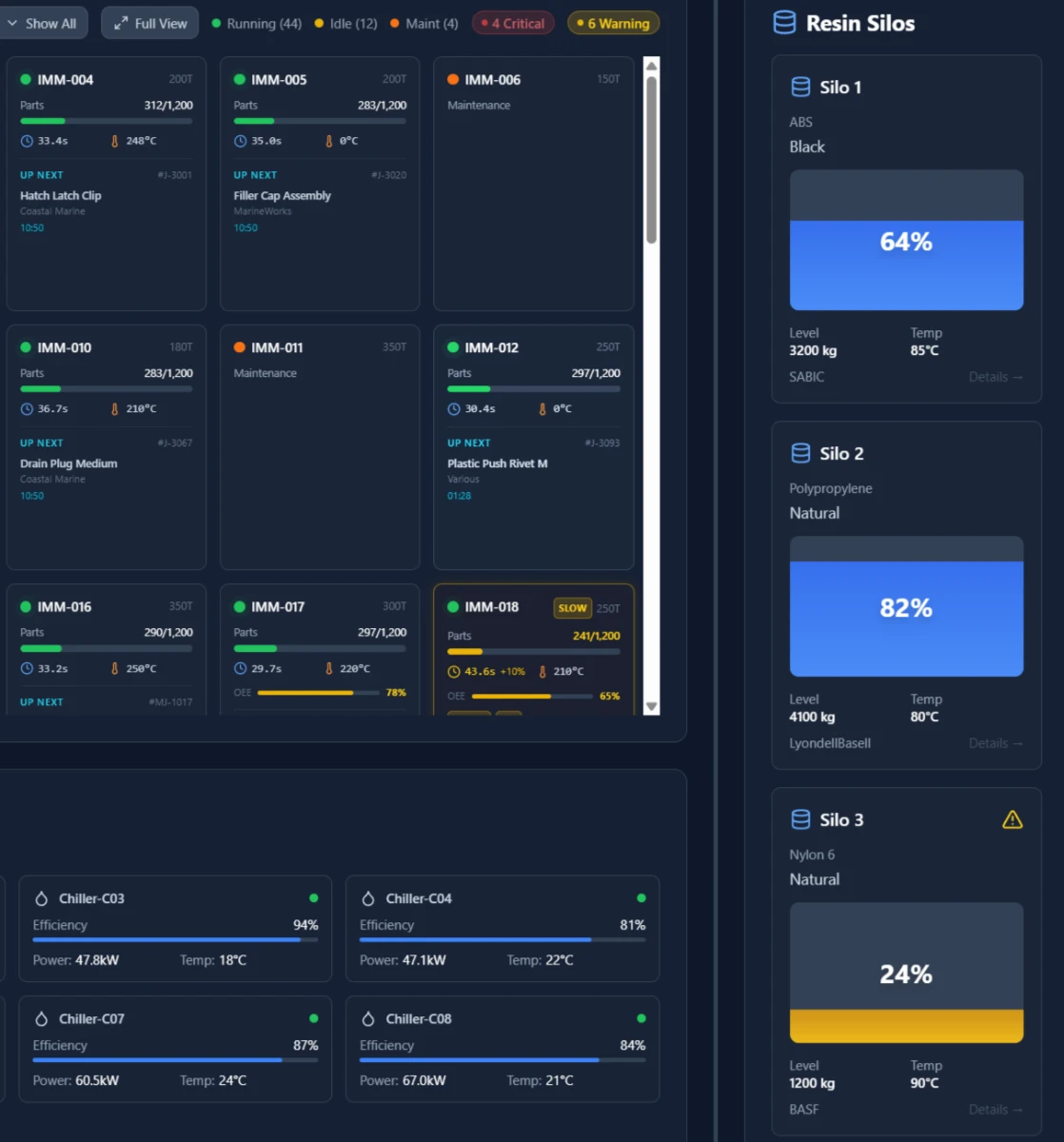
Injection Molding Software: Why Most Shops Are Still Flying Blind
If you run an injection molding operation, you already know the drill. The press finishes a run, someone writes the cycle count on a whiteboard, a supervisor updates a spreadsheet at the end of shift, and by the time that data reaches your ERP, it's hours old. Decisions that needed to happen at 2 PM are being made with 6 AM numbers.
That gap — between what's happening on the floor and what your system knows — is where margin goes to die.
Injection molding software should close that gap. Most of what's on the market doesn't. This article breaks down why, what the real requirements look like, and how MonitorZ was built specifically to solve the problems that generic ERP platforms leave unaddressed.
What Makes Injection Molding Different from Other Manufacturing
Injection molding isn't discrete assembly. You're not bolting parts together in a sequence. You're running a process — highly repetitive, highly time-sensitive, with tight tolerance windows and a cost structure that punishes variation.
A few things make injection molding operationally distinct:
- Cycle time is everything. A press running at 28 seconds instead of 24 seconds doesn't sound catastrophic until you realize you just lost 600 shots over an 8-hour shift. At even modest piece prices, that's a real number.
- Mold changes are expensive transitions. A changeover on a 500-ton press isn't a 10-minute task. Mold heat-up, purge cycles, trial shots — you need to plan these windows carefully or your schedule falls apart mid-shift.
- Scrap tracking is nuanced. First-article scrap, startup scrap, mid-run scrap, and end-of-run scrap have different causes and different responses. Lumping them together in a generic "scrap" field tells you nothing actionable.
- Quality holds can cascade fast. A cosmetic defect on a part with a 200-piece buffer doesn't feel urgent — until that buffer runs out and you're holding a production line downstream.
- Material management is process-critical. Moisture content, regrind ratios, lot traceability — none of this is optional in most molding environments. Generic inventory modules weren't designed for it.
Most ERP systems treat injection molding like any other shop order. They track quantity in, quantity out, and call it done. That's not software for injection molding — that's software that tolerates injection molding.
The Core Failure of Generic Manufacturing Software
Here's what generic platforms get wrong: they're built around transactions, not velocity.
A transaction tells you that 5,000 parts were completed. Velocity tells you how fast inventory is moving through your operation — from raw pellet to finished part to shipping dock. When you manage by transactions, you find out what happened after it happened. When you manage by velocity, you can see problems forming in real time and act before they compound.
MonitorZ is built on a methodology called Object Velocity — a framework that re-models your operational data down to its most granular unit: the individual inventory object. Every physical item in your facility gets a unique identifier. Every movement, every status change, every quality event gets captured at the point of action — on the floor, by the press operator, in real time.
That's the difference between knowing that a run finished and knowing how that run performed every step of the way.
What MonitorZ Tracks That Other Systems Don't
Press-Level Cycle Performance
MonitorZ captures cycle time at the machine level throughout the run — not just a summary at completion. If a press is trending slow by 8% at the 90-minute mark, your supervisor sees that now, not at end of shift. The root cause analysis happens while the run is still active and correctable.
Mold Change Planning and Execution
MonitorZ's Bill of Materials Flow Router (BFR) generates schedules of Planned Objects (PLOBs) — digital placeholders that represent upcoming production needs based on orders, forecasts, and current inventory levels. For injection molding, this means your mold change schedule is dynamically generated around actual demand, not a static plan that was accurate when it was built two weeks ago.
When a customer pulls an order forward, or a run yields short, the PLOBs update automatically. The schedule reflects reality.
Granular Scrap Classification
MonitorZ tracks scrap by type and by timing within the run. Startup scrap, steady-state scrap, and tail-end scrap are captured separately. This isn't just cleaner reporting — it's the difference between knowing you have a scrap problem and knowing whether it's a process startup issue, a tool wear issue, or an operator execution issue. Those three problems have completely different solutions.
Material Lot Traceability
Every Inventory Object (OB) in MonitorZ carries its lineage — what material lot it came from, what regrind ratio was used, what press and mold it was produced on, and when. If a quality issue surfaces at a customer's facility three weeks later, you can trace it back to the exact production window in minutes, not days.
Real-Time Quality Hold Management
When a quality hold is triggered in MonitorZ, the system doesn't just flag it — it immediately calculates downstream impact. How many units are affected? What orders are at risk? What's the estimated time to resolve based on current capacity? You get a problem and a context at the same time, so the response is faster and more accurate.
Mobile-First Data Collection: Why It Changes Everything
One of the most persistent failures in injection molding software is the assumption that data entry happens at a desk. It doesn't. It happens at the press, at the QC bench, at the material staging area, and at the shipping dock.
MonitorZ is built mobile-first. Press operators use smartphones or tablets to capture data directly at the point of action via QR code scanning. There's no paper traveler that gets keyed in at end of shift. There's no clipboard that lives on the press for three days and then gets handed to someone to transcribe.
Training takes under five minutes. A worker scans a QR code on a mold, scans a QR code on a material lot, scans a QR code on a finished tote — and the system records a complete production event with no manual text entry required.
This matters for three reasons:
- Data latency drops to near zero. Your ERP knows what happened at the press within seconds of it happening.
- Data accuracy improves dramatically. Human transcription errors disappear when there's no transcription step.
- Labor cost for data management drops. The hours your team spends entering, verifying, and correcting production data every day don't need to exist.
AI-Driven Execution in the Press Room
MonitorZ doesn't just capture data — it acts on it. The platform integrates five AI capabilities tuned specifically for manufacturing execution:
- Object Detection: Classifies physical inventory and flags anomalies in part count or quality without manual inspection at every step.
- Predictive Forecasting: Projects when you'll run short of material, when a tool will need service based on shot count, and when a press is trending toward downtime based on cycle performance patterns.
- OCR and Keyword Extraction: Reads shipping labels, material certifications, and work order documents automatically — no manual data entry for paperwork that used to take 20 minutes per run.
- Sentiment and Variance Analysis: Evaluates production data for patterns that human review would miss — subtle cycle time creep, correlation between material lots and scrap rates, shift-by-shift performance variance.
The result is a system that doesn't wait for a supervisor to notice a problem. It surfaces problems before they become crises.
Integration: Where MonitorZ Fits in Your Stack
MonitorZ isn't a replacement for your accounting system or your quoting tool. It's a manufacturing execution and intelligence layer that connects your floor operations to whatever business systems you already use.
For shops running Zoho, MonitorZ integrates natively with Zoho's manufacturing modules, extending their capability with press-level data capture and real-time scheduling that Zoho's core platform wasn't designed to handle alone. The same applies to QuickBooks, Business Central, and other common ERP platforms used by small to mid-size molders.
You don't rip and replace. You add the capability your current system is missing.
What the Numbers Look Like
Injection molding shops that implement MonitorZ typically see measurable results within the first 90 to 120 days:
- A 130% increase in production throughput by eliminating the scheduling gaps and data latency that suppress press utilization.
- A 47% reduction in direct operational costs through automation of manual data entry, reduction in scrap from earlier problem detection, and elimination of expediting caused by poor schedule visibility.
- Elimination of end-of-shift data entry as a category — press operators capture data as they work, not as an administrative task after the work is done.
These aren't projections built on best-case scenarios. They're outcomes from production environments where the gap between what the system knew and what was actually happening was finally closed.
What to Look For When Evaluating Injection Molding Software
If you're evaluating options, here's a practical checklist. Push any vendor on these points:
- Does it capture data at the press in real time, or does data enter the system after the fact? After-the-fact data entry is the core failure mode of most manufacturing software.
- Can it track scrap by type and by position within a run? If not, it can't help you reduce it.
- Does the schedule update dynamically when conditions change? A static schedule that requires manual intervention every time something shifts is a scheduling tool that creates work instead of eliminating it.
- Is the mobile interface usable on a press floor without training? If it takes more than five minutes to teach, the adoption will fail.
- Can you trace a finished part back to its material lot? In regulated environments and automotive supply chains, this isn't optional.
The Bottom Line
Injection molding is a precision process. The software managing it should be equally precise. Generic ERP platforms offer transaction tracking. MonitorZ offers operational intelligence — the real-time visibility, automated execution, and predictive capability that injection molding operations need to run at the margin they're capable of.
If your current system is giving you yesterday's data to make today's decisions, it's time to look at what's possible when the gap between your floor and your software finally closes.
See MonitorZ in action in your environment. Schedule a demo and we'll show you what your operation looks like when the data is live.
Tags
Ready to Transform Your Manufacturing?
See how MonitorZ can help your business streamline operations, reduce costs, and accelerate growth with seamless Zoho integration.